How to Read a Japanese Business Card, Line by Line
How to read a Japanese business card (meishi) line by line on a sample card, from company and title to family name, furigana, address and phone numbers.
Here’s how to read a Japanese business card: identify the company, the department and job title, then the person’s name, and finally the address (after the postal mark 〒) and phone numbers. Japanese names usually put the family name first; if the card gives the reading in small kana (furigana) or in roman letters, use it to check the pronunciation. If the card has an English side, use it as a cross-check rather than a replacement. This guide walks through a sample card line by line and ends with a cheat sheet you can keep on your phone.
How to read a Japanese business card: where to start
The card below is a sample we made up for this article. The company, person, building and contact details are fictional examples. Do not use them to contact anyone.
| Line | On the card | What it means |
|---|---|---|
| ① | サンプルシステム株式会社 | Company: Sample System Co., Ltd. |
| ② | 東京本社 第二開発部 | Office and department: Tokyo head office, Development Department No. 2 |
| ③ | 部長 | Title: department manager (buchō) |
| ④ | 佐藤 花子 | Name: family name 佐藤 (Satō), given name 花子 (Hanako) |
| ⑤ | さとう はなこ / Hanako Sato | Reading of the name: furigana and roman letters |
| ⑥ | 〒100-0000 東京都千代田区サンプル町1-2-3 サンプルタワー12F | Postal code and address (fictional) |
| ⑦ | TEL 03-0000-1234(直通) | Direct line |
| ⑧ | 携帯 080-0000-5678 | Mobile phone |
| ⑨ | hanako.sato@example.com |
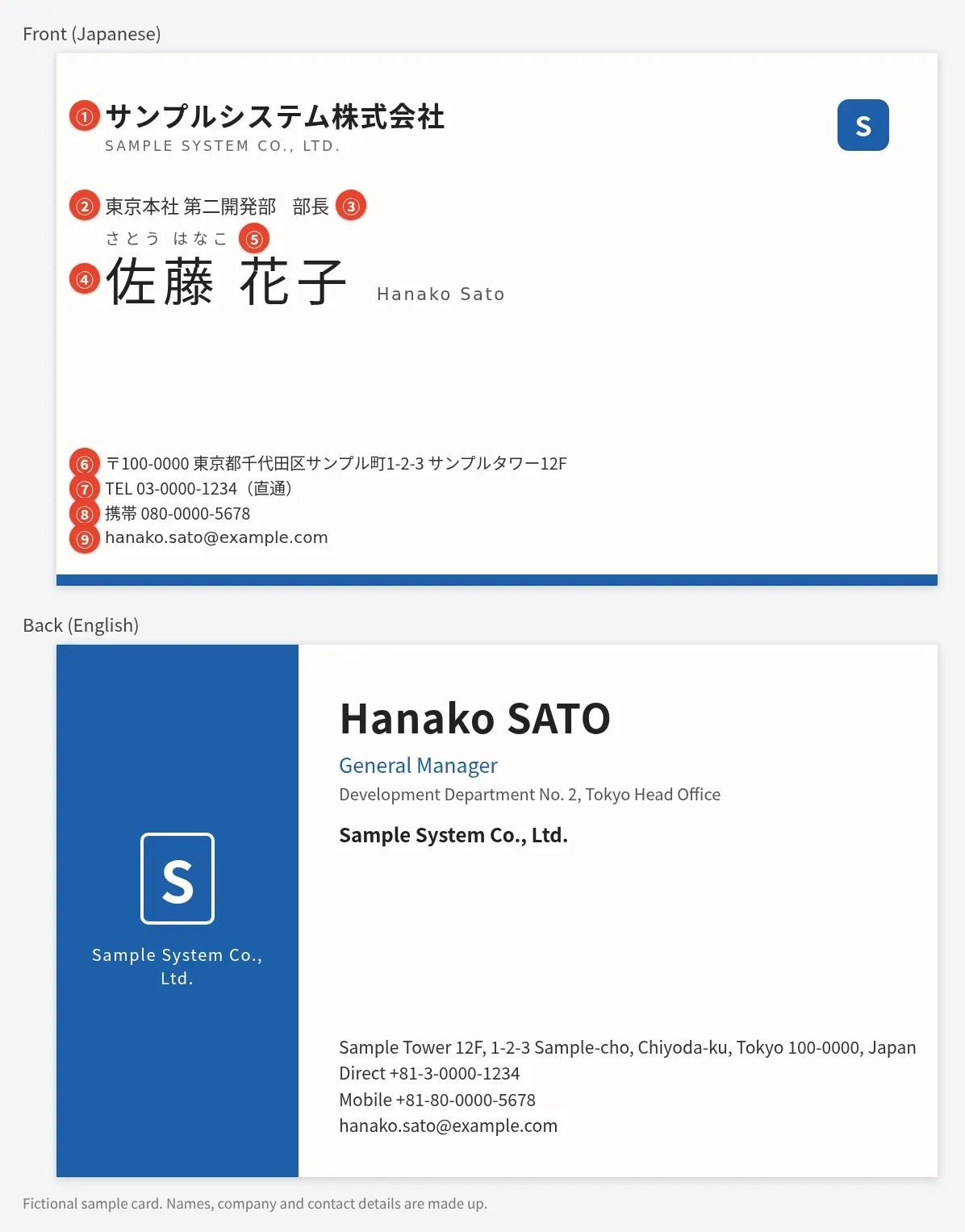
Real cards vary. Some are printed vertically, some put a large logo at the top, and many have no furigana or mobile number. So don’t rely on position or font size alone; look for the keywords explained below.
Company name: why 株式会社 can come first or last
株式会社 (kabushiki kaisha, often shortened to K.K.) means a stock company, roughly “Co., Ltd.” or “Inc.” It can appear before the name (株式会社サンプル) or after it (サンプル株式会社). The position is part of the company’s name, so copy it exactly as printed when you save the contact or address an email.
Other words you may see (the English equivalents are approximate):
- 合同会社 (gōdō kaisha, G.K.): another company type, similar to an LLC.
- 有限会社 (yūgen kaisha): another company type you may still see on cards.
- 本社 (honsha): head office. 支店 (shiten) or 営業所 (eigyōsho): branch or sales office.
The name: family name first, and how to say it
Which part is the family name?
Names written in Japanese usually put the family name first. In 佐藤 花子, 佐藤 (Satō) is the family name and 花子 (Hanako) is the given name. The English side often flips the order to “Hanako Sato”, and some cards write the family name in capitals (“Hanako SATO” or “SATO Hanako”) to make it clear. If you are unsure which part is the family name, check the other side of the card or ask the person.
Romanized spellings vary: Satō may appear as Sato, Satoh or Satou. Use the spelling printed on the card when you write to the person.
How can furigana help you pronounce the name?
The same kanji can be read in several ways, especially in names. That is why many cards print the reading in small kana above or next to the name. This is called furigana (振り仮名), and it may be in hiragana (さとう はなこ) or katakana (サトウ ハナコ); both give the same reading.
If there is no furigana and no English side, it is fine to ask when you receive the card:
お名前は何とお読みすればよろしいでしょうか。 (Onamae wa nan to oyomi sureba yoroshii deshō ka?) “How should I read your name?”
Because Japanese names can be read in more than one way, asking at the start is better than getting the name wrong later.
How to address the person
In conversation, family name + さん is widely used with people from other companies; in formal settings, follow how your colleagues or the person introducing you address them. Given names are generally not used unless the person invites you to. In emails to clients or other companies, Japanese writers usually use 様 (sama) instead: 佐藤様. Don’t add san or sama to your own name.
How do you read departments and job titles?
Departments are usually written from large to small: 本部 (division), 部 (department), 課 (section). The title may come after the department or above the name. English translations differ from company to company, so treat the table below as a rough guide to reading the card, not as a statement of anyone’s legal authority.
| Title | Reading | Rough English equivalent |
|---|---|---|
| 代表取締役 | daihyō torishimariyaku | Representative director |
| 社長 | shachō | President |
| 取締役 | torishimariyaku | Director (board member) |
| 部長 | buchō | General manager of a department |
| 課長 | kachō | Section manager |
| 係長 | kakarichō | Team leader, supervisor |
| 主任 | shunin | Senior staff (the role varies by company) |
| 担当 | tantō | Person in charge (not a management title) |
In a typical company, 部長 ranks above 課長, and a department may contain several sections (課). Be careful with 代表: next to a phone number it simply means the company’s main line, not a title.
How do you read the address and phone numbers?
Reading a Japanese address
The mark 〒 is the Japanese postal symbol, followed by a seven-digit postal code (100-0000 in our sample is only an illustration). Japanese addresses run from large to small: prefecture (都, 道, 府 or 県), city or ward, district, block and building numbers, then the building name. “12F” means 12th floor. The English side may list the address from smaller to larger units.
If a map app can’t find the romanized address, try pasting the Japanese line from the card.
Phone number labels
| On the card | Meaning |
|---|---|
| TEL, 電話 | Telephone; check the label and prefix to see what kind |
| 代表 | Company main line |
| 直通 | Direct line to the person or team |
| 内線 | Extension; enter it as the switchboard instructs or ask to be put through |
| 携帯 | Mobile, usually starting with 090, 080 or 070 |
| FAX | Fax number |
To save a number in international format, add Japan’s country code +81 and drop the leading 0. For example, 03-0000-1234 becomes +81-3-0000-1234, and 080-0000-5678 becomes +81-80-0000-5678. Extensions stay as they are, and some special service numbers can’t be dialled from abroad.
The English side: use it to cross-check
Companies that work with international clients often print an English side. It helps with the name and address, but English job titles do not always correspond directly to the Japanese titles: 課長 might be translated as “Manager” or “Section Chief”. Read both sides, and if you need the exact title for a contract or official document, ask the person.
Cheat sheet: words and marks you will see on Japanese business cards
| Word or mark | Reading | Meaning |
|---|---|---|
| 名刺 | meishi | Business card |
| 株式会社 | kabushiki kaisha | Stock company (Co., Ltd., K.K.) |
| 本社 / 支店 | honsha / shiten | Head office / branch |
| 営業部 | eigyōbu | Sales department |
| 開発部 | kaihatsubu | Development department |
| 総務部 | sōmubu | General affairs department |
| 人事部 | jinjibu | Human resources department |
| 経理部 | keiribu | Accounting department |
| 海外 | kaigai | Overseas, international |
| 〒 | yūbin kigō | Postal symbol, before the postal code |
| 郵便番号 | yūbin bangō | Postal code |
| 代表 | daihyō | Representative; on a phone line, the main number |
| 直通 | chokutsū | Direct line |
| 内線 | naisen | Extension |
| 携帯 | keitai | Mobile phone |
| 様 / さん | sama / san | Honorifics added after a family name |
How can you save a Japanese business card without typing kanji?
Understanding a card is one thing; typing its kanji into your contacts is another, especially without a Japanese keyboard. A business card scanner that reads Japanese can do this part for you.
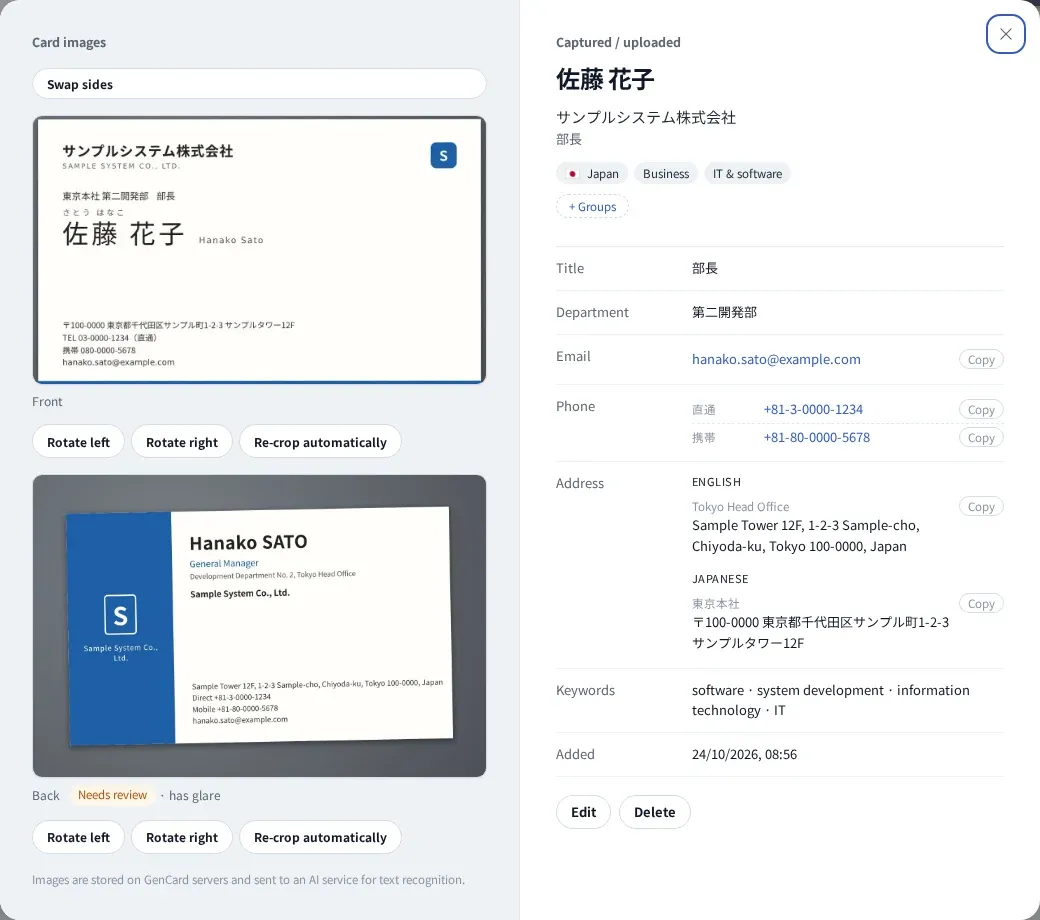
With GenCard, you take a photo of the card with your phone. The AI reads Japanese (kanji and kana), English and Vietnamese cards and splits them into fields such as name, company, title, department, phone, email and address. For cards with an English back, the Single card, both sides camera mode saves the two sides as one card. The camera scanning guide explains how to get clean photos.
Sample data
After scanning, compare the fields with the card, especially the name and phone numbers. Cards the AI is unsure about get a Needs review label so you can check them first. The Free plan adds 10 AI credits a day, up to a balance of 50, and each card uses one credit whether it has one side or two. The interface and the assistant are available in English, Japanese and Vietnamese. See what GenCard can do, the plans and prices, and the FAQ on languages, accuracy and devices.
FAQ
What if the card has no furigana?
Check the English side if there is one. If not, ask when you receive the card (“お名前は何とお読みすればよろしいでしょうか”) and write the reading in the notes of your contact so you don’t forget it.
Which is the family name on a Japanese business card?
Names written in Japanese usually put the family name first. On the English side, the order may be reversed. If only one part is written in capitals, it is often the family name, but ask if you are unsure.
Is a 部長 more senior than a 課長?
In a typical company, yes: 部長 (department manager) ranks above 課長 (section manager). Exact structures still vary between companies.
Can I write notes on a card I just received?
To be safe, avoid writing on a card in front of the person who gave it. Add notes such as the meeting date or topic after the meeting, or in your contacts app.